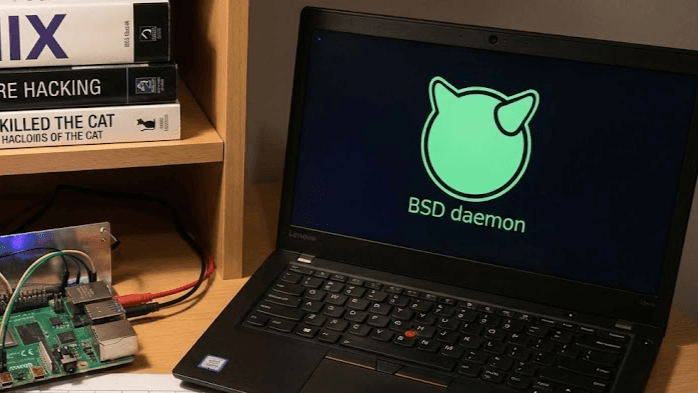
As a hardware engineer working primarily in IoT systems, my world has been Linux-centric — specifically Debian for embedded applications. Recently, I stumbled upon Berkeley Software Distribution (BSD) systems and got curious: could these Unix variants offer advantages for embedded and IoT work? Here's what I discovered.
What Are BSD Systems?
BSD originated at UC Berkeley in the 1970s and '80s as an enhanced Unix variant. After legal battles with AT&T in the early 1990s, the code was freed of proprietary elements, spawning today's open-source BSD systems. The major variants each have distinct philosophies:
FreeBSD — The most popular, focusing on performance and advanced features. Known for excellent networking and widespread commercial use (Netflix, PlayStation, WhatsApp infrastructure).
NetBSD — Built around extreme portability (runs on over 50 hardware architectures). The motto "Of course it runs NetBSD" says it all. Ideal for embedded systems and legacy hardware.
OpenBSD — Uncompromising focus on security and code correctness. Developed OpenSSH and many security technologies now industry standard. Security over features, always.
DragonFly BSD — Forked from FreeBSD to explore radical multiprocessing architecture. Experimental focus on SMP scalability.
The BSD vs. Linux Difference
Coming from Debian, the architectural differences were eye-opening.
Integrated vs. Modular
BSD ships as a complete, integrated operating system with kernel and userland developed together in one source tree. Linux distributions like Debian assemble thousands of independently developed packages. For embedded work, BSD's cohesive approach means more predictable behavior; Linux's modular approach offers finer control.
Licensing Philosophy
BSD uses permissive licensing allowing proprietary derivatives — why Apple's macOS and Sony's PlayStation can use BSD code. Linux's GPL requires derivative works stay open source. Different philosophies, different business models.
System Management
BSD uses centralized configuration (/etc/rc.conf), while Linux uses scattered configs and systemd. BSD man pages are famously comprehensive; Linux documentation is more scattered but extensive.
The Security Question: OpenBSD for IoT?
Security is increasingly critical in IoT. OpenBSD's reputation here is stellar: proactive security features, continuous code auditing, minimal attack surface by design. On paper, it seems perfect for long-lived IoT devices exposed to networks for years.
The reality is more nuanced.
OpenBSD's Security Strengths
- Memory protections (W^X, ASLR) that other systems adopted years later
- Rigorous, ongoing code audits across the entire codebase
- Security-first culture: when vulnerabilities are found, they audit for similar issues everywhere
- Lean base system with minimal attack surface
The Embedded Reality Check
- Limited hardware support — Conservative about new hardware. Many IoT SoCs simply aren't supported
- Driver availability — Even supported hardware may lack peripheral drivers for sensors, wireless chips, industrial interfaces
- Cross-compilation complexity — Not as mature as Linux toolchains (Buildroot, Yocto)
- Smaller ecosystem — Fewer packages, less community support for embedded-specific issues
- Vendor support — IoT vendors provide Linux BSPs, not BSD
For most embedded/IoT work, Linux's hardware support advantage outweighs OpenBSD's security advantage.
Understanding "Hardening"
This research introduced me to the concept of system hardening — a term I'd heard but never deeply understood.
Hardening means reducing a system's attack surface and increasing resilience by:
- Removing unnecessary services, software, and features
- Configuring components with minimum necessary privileges
- Implementing additional security controls
- Making exploitation harder, even when vulnerabilities exist
Practical Hardening for Embedded Linux
Instead of switching to OpenBSD, you can harden Debian/Linux significantly.
Minimize Attack Surface
- Install only necessary packages (50–100 vs. 500+ in stock Debian)
- Disable unused services
- Remove unnecessary kernel modules
Least Privilege
- Run applications as dedicated non-root users
- Use Linux capabilities for specific privileges
- Implement AppArmor or SELinux for mandatory access control
Defense in Depth
- Configure firewalls even on "trusted" networks
- Use read-only root filesystems
- Encrypt sensitive data at rest
- Implement secure boot
Kernel Hardening
- Enable ASLR, stack protection, and other security features
- Restrict kernel features after boot
- Use seccomp to limit system calls
Network Security
- Strong authentication (SSH keys, certificates)
- Encrypt all communications
- Network segmentation for IoT devices
OpenBSD vs. Hardening
The key difference: OpenBSD ships hardened by default. Linux distributions start general-purpose — you must harden them. OpenBSD leaves less room for configuration mistakes, but Linux gives you the flexibility and hardware support needed for most embedded work.
Where BSD Makes Sense for IoT/Embedded
Despite limitations, BSD has viable embedded use cases:
Gateway/Edge Devices — If building on x86/x64 or well-supported ARM, OpenBSD offers excellent security for aggregation points.
Industrial Controllers — x86/x64 embedded systems benefit from OpenBSD's security and stability for long-lived equipment.
Backend Infrastructure — Servers collecting IoT data can absolutely run BSD with security advantages.
Exploration and Learning — NetBSD's portability focus offers valuable lessons in embedded systems design.
My Takeaway
For IoT/embedded work, hardened Linux (particularly Debian, given my background) remains the practical choice. Hardware support, vendor BSPs, and ecosystem advantages are simply too significant to ignore.
However, exploring BSD systems taught me:
- Security by design is a matter of discipline — OpenBSD's approach informs better practices regardless of OS choice
- Integrated systems have advantages — BSD's cohesive development model offers lessons for embedded systems architecture
- Hardening is essential — Understanding and implementing proper system hardening is critical for IoT security
- Trade-offs are real — Every architectural choice involves balancing security, compatibility, support, and complexity
If you're in embedded/IoT, I'd recommend:
- Stay with Linux for hardware compatibility
- Learn hardening principles (BSD is a great teacher here)
- Standardize your hardening approach across projects
- Consider BSD for specific use cases where hardware support aligns
The best security comes not from switching operating systems, but from understanding security principles deeply and applying them consistently — regardless of your platform choice.
What's your experience with BSD or system hardening in embedded applications? I'd love to hear perspectives from others working in this space.